Every voyage has a story. Now your boat’s instruments can help tell it, automatically.
By Steve Harding, founder6 min read
There’s a quiet conversation happening aboard your boat every time you leave the marina.
Your GPS knows precisely where you are. Your depth sounder watches the water beneath the hull. Your engine keeps track of every revolution, every minute of running time. And somewhere on the network, your instruments are building a remarkably detailed picture of your journey.
The trouble is, most of that information never makes it into your logbook.
Until now.
With the latest update to Saltlog, your boat can tell its own story. Saltlog can listen directly to your onboard instruments, gathering the details of each voyage and keeping them alongside your memories of the trip.
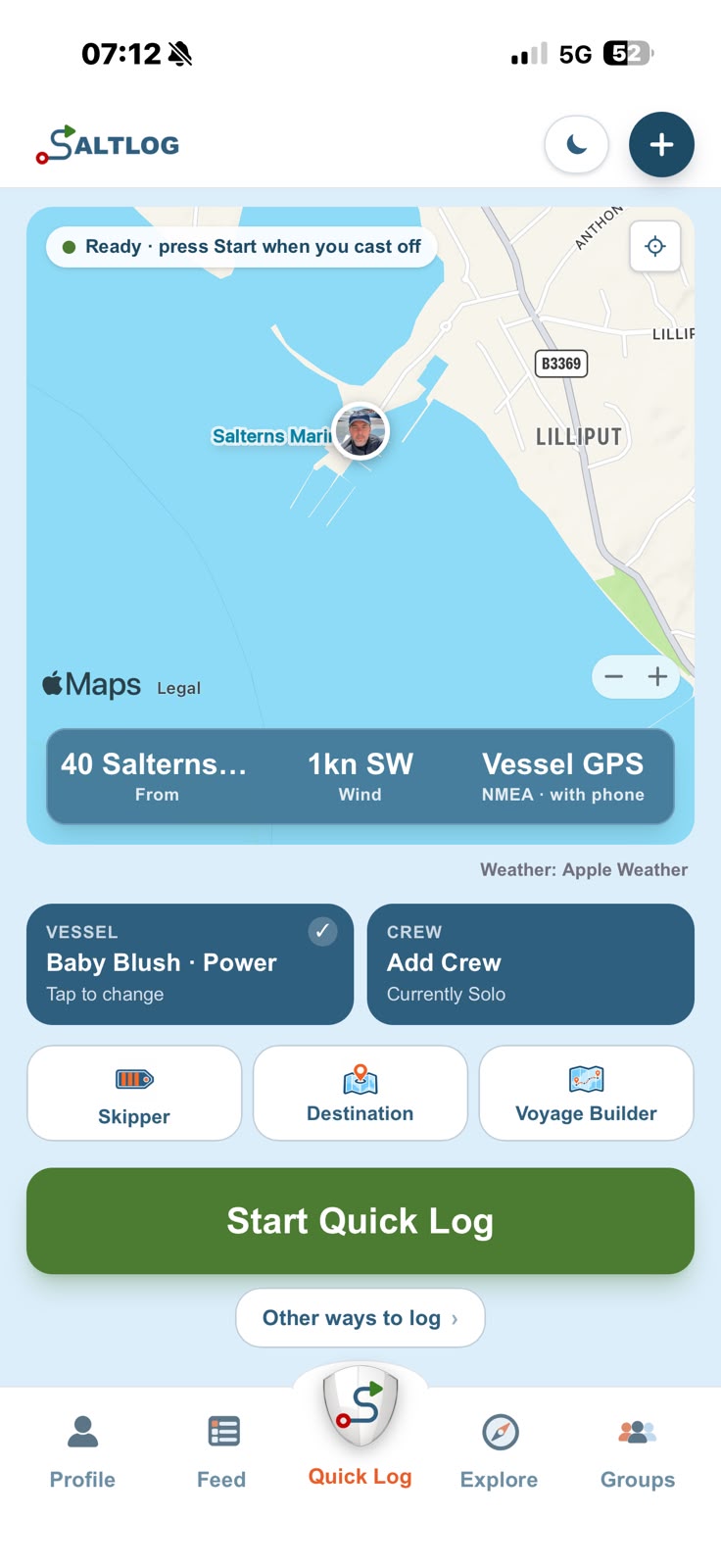
No scribbled readings. No trying to remember the engine hours when you get home. Just press Start Quick Log, cast off, and let the boat do the talking.
A logbook that knows your boat
Your phone is already remarkably good at tracking a journey. But your boat has a few advantages.
Its GPS antenna has a clear view of the sky. Its depth sounder knows what’s happening beneath the surface. And its engine instruments know things your phone could never discover.
Connect Saltlog to those instruments, and your voyage log becomes richer, more accurate and more useful.
01 / PositionA position you can trustSaltlog can use your boat’s own GPS. Trips recorded with it are marked GPS Verified.
02 / DetailThe things you never write downShallowest depth, water temperature, engine running time and top revs, when your instruments provide them.
03 / SimplicityNothing extra to rememberPress Start, enjoy the trip, and let Saltlog collect the details.
It’s information that becomes more valuable over time, especially when you look back at a season and want to understand not just where you went, but how the boat performed along the way.
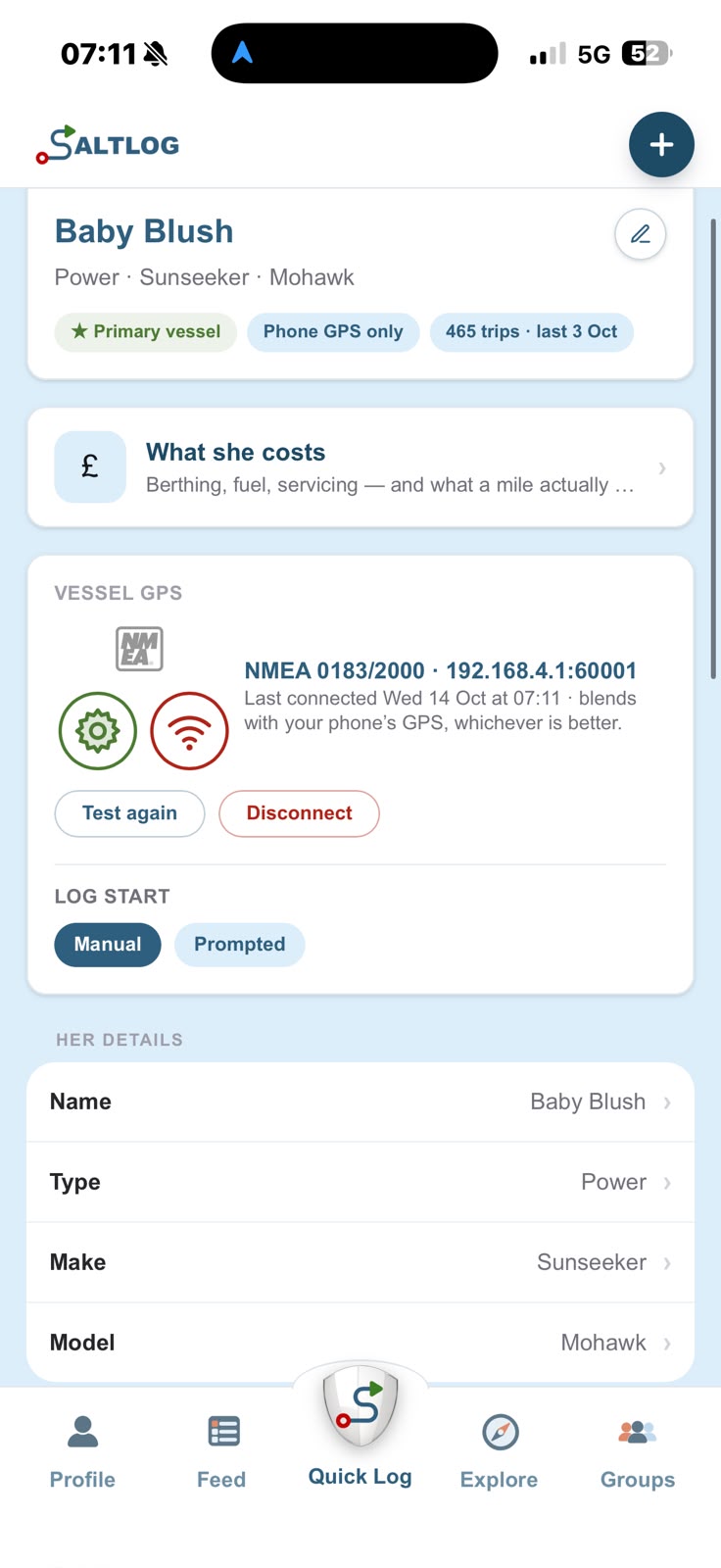
Quick Log and the vessel page: the boat’s GPS becomes part of your everyday logging.
Giving the boat a voice
Most modern boats already have an electronic network connecting the chartplotter, depth sounder, engine and other instruments. Saltlog now offers two ways to listen in.
Connection 01
The simple route: an NMEA Wi-Fi gateway
For many boat owners, this will be the easiest way to get started.
A small Wi-Fi gateway takes information from the boat’s instrument network and makes it available to apps. Devices from companies such as Actisense, Digital Yacht, Yacht Devices and Vesper can provide this bridge.
If you’ve already got one aboard, you may have everything you need.
NMEA
NMEA 0183 and NMEA 2000The two most widely used marine networking standards. A compatible Wi-Fi gateway makes their data available to Saltlog.
Getting connected
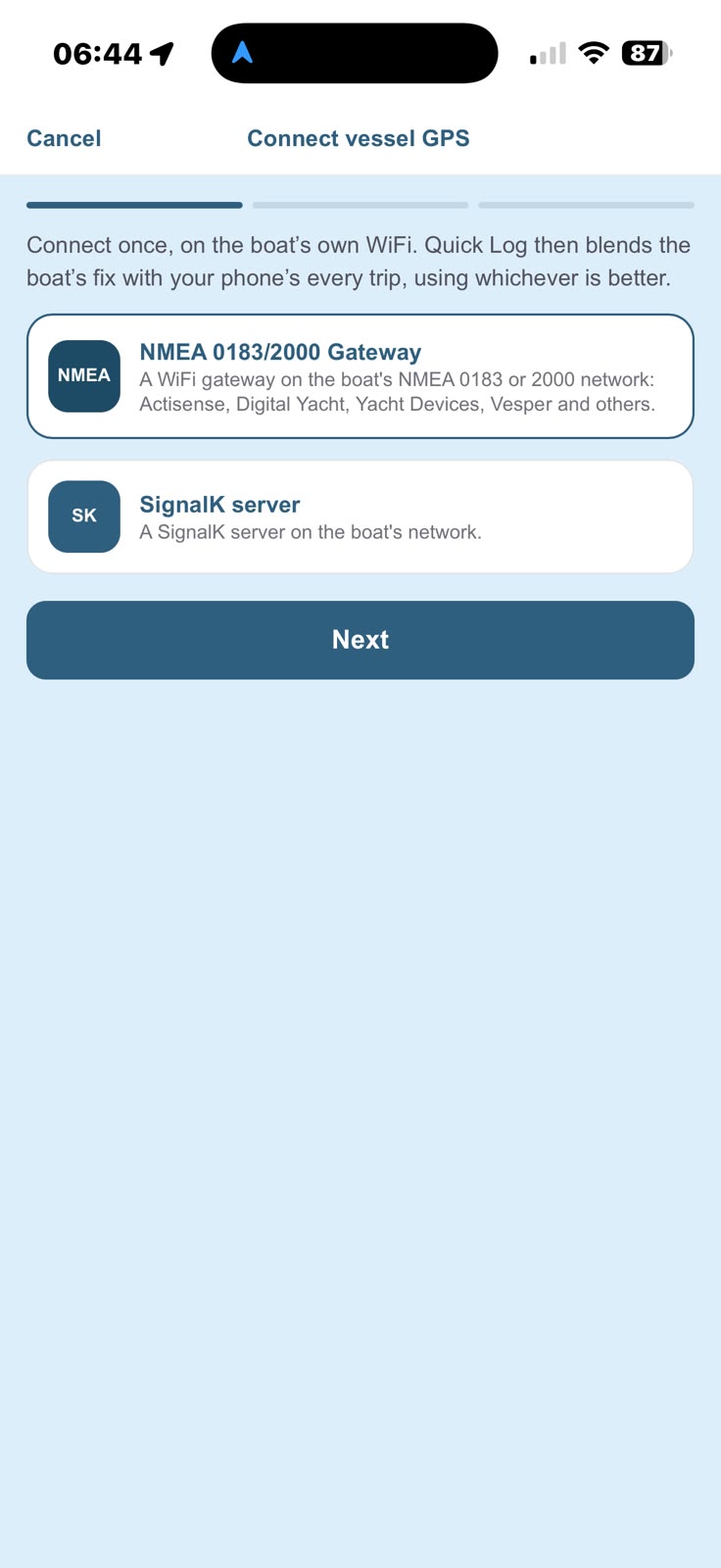
Join your phone to the boat’s Wi-Fi network.
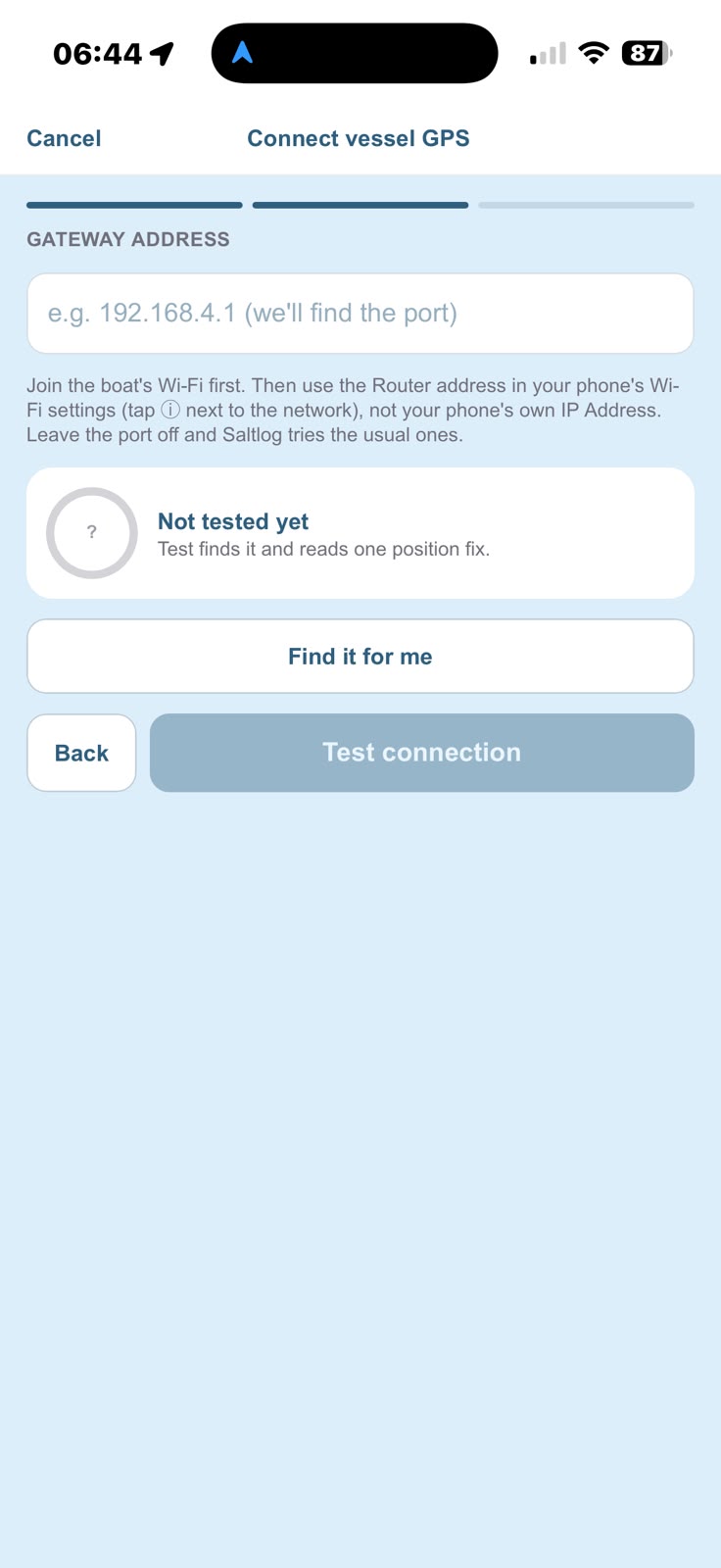
Open your vessel in Saltlog and tap Connect vessel GPS.
Choose NMEA 0183/2000 Gateway and tap Find it for me.
Saltlog finds the gateway, tests the connection and reads its first position fix.
Once connected, Saltlog knows when your boat’s instruments are in range and collects what they send during your voyage.
The connection steps: choose your type of network, then let Saltlog look for the gateway.
Tested on my own boat
And yes, I’ve been testing this myself.
On my own motor boat, with a Garmin chartplotter and Mercury SmartCraft on the network, Saltlog recorded the trip using the boat’s GPS and marked it GPS Verified. Seeing it work for the first time was a rather satisfying moment.
Of course, no two boats are wired quite the same way. Different gateways and instruments send different combinations of information. That’s why we’ve also built a data-discovery tool, to help us understand what’s available and pick out the most useful information to bring into future versions of the logbook.
If there’s something your boat knows that you think Saltlog should remember, I’d genuinely love to hear about it: support@saltlog.co.uk.
Connection 02
The bigger picture: Signal K
There’s one catch with traditional NMEA gateways.
Modern NMEA 2000 networks carry an extraordinary amount of information, but converting it into the older NMEA 0183 format can lose some of the detail along the way.
That’s where Signal K comes in.
SK
Signal KA free, open marine data standard that gathers your boat’s information in one modern, consistent format.
Usually running on a small onboard computer, such as a Raspberry Pi with OpenPlotter, a Signal K server can bring a much broader range of instrument data together. And Saltlog can listen to that, too.
Depending on your equipment, that could mean recording engine temperature, oil pressure, fuel, tank levels, battery voltage and more.
It opens the door to a logbook that does more than tell you where you’ve been. Over time, it can build a much fuller picture of how your boat behaves.
I’m currently fitting a Raspberry Pi with a PiCAN-M board behind the helm of my own boat to explore exactly what’s possible. There will be another post about that adventure, including what works, what doesn’t, and hopefully not too much time spent upside down beneath the dashboard.
Technology that stays in the background
The important thing, to me, is that Saltlog shouldn’t turn boating into another technical chore.
A voyage is about being on the water. The engine starting, the lines coming aboard, the view opening up as you leave the harbour. You shouldn’t have to become a network engineer to keep a decent logbook.
That’s the thinking behind this update. Connect your instruments once, then use Quick Log just as you always have. Saltlog blends your phone’s GPS with the boat’s own position, using whichever gives the better fix.
The electronics gather the facts. You get on with the boating.
Tell us what your boat knows.
What instruments are you using? What would you love Saltlog to capture next?
And when you look back at a trip, there’s a little more of the boat’s story waiting for you.
Part of Saltlog Plus
Connecting Saltlog to your boat’s instruments is part of Saltlog Plus.
But the heart of Saltlog isn’t changing. You can still log as many trips as you like with your phone’s GPS, completely free. The instrument connection is there for owners who want to go a little further and make the most of the electronics already aboard.
Your boat already knows the journey. Now your logbook can know it too.
If you give it a try, please tell me how you get on, which gateway you’re using, and which instruments you’ve connected. Feedback from real boats is what helps us decide what to build next.